
TRIVETOLOGY
Collecting, cleaning, displaying, researching, and appreciating TRIVETS and related go-withs!
The fabulous Fly trivet
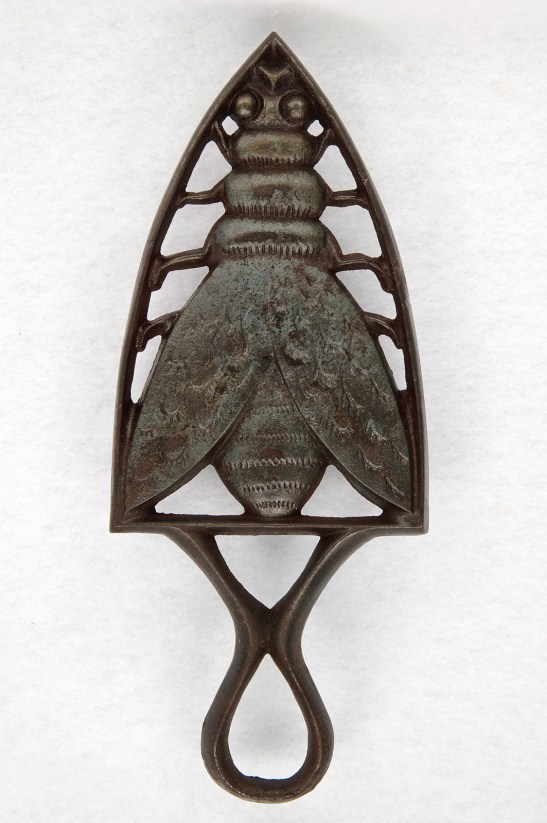
Cast iron, 9″ x 3.75″ with three 1.25″ legs
My fabulous fly trivet is highly detailed on the front and unsigned on the reverse. The measurements are the same as the brass example on p.179 of Kelly & Ellwood’s 1990 book A Collectors Guide To Trivets & Stands (T&S).
Another example appears on p.141 of Esther Berney’s 1977 book A Collectors Guide To Pressing Irons and Trivets. She wrote: “To incorporate animals, birds or insects in trivet designs took greater craftsmanship than producing a similar geometric motif. That is why fewer such trivets were made.”
There’s ongoing debate among collectors as to whether this design represents a fly or a bee; you be the judge. Personally, I still believe it’s a fly, considering the design shows one pair of wings. A honeybee, in contrast, has two separate wings – a forewing and a hindwing – on each side.
Update 11/5/19

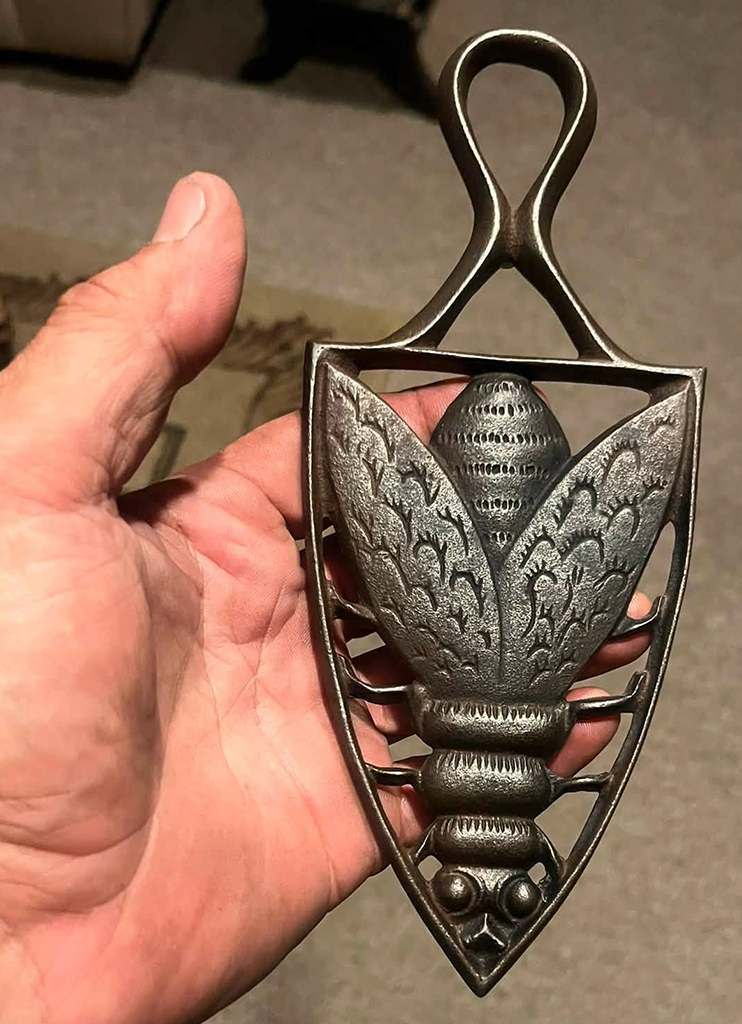
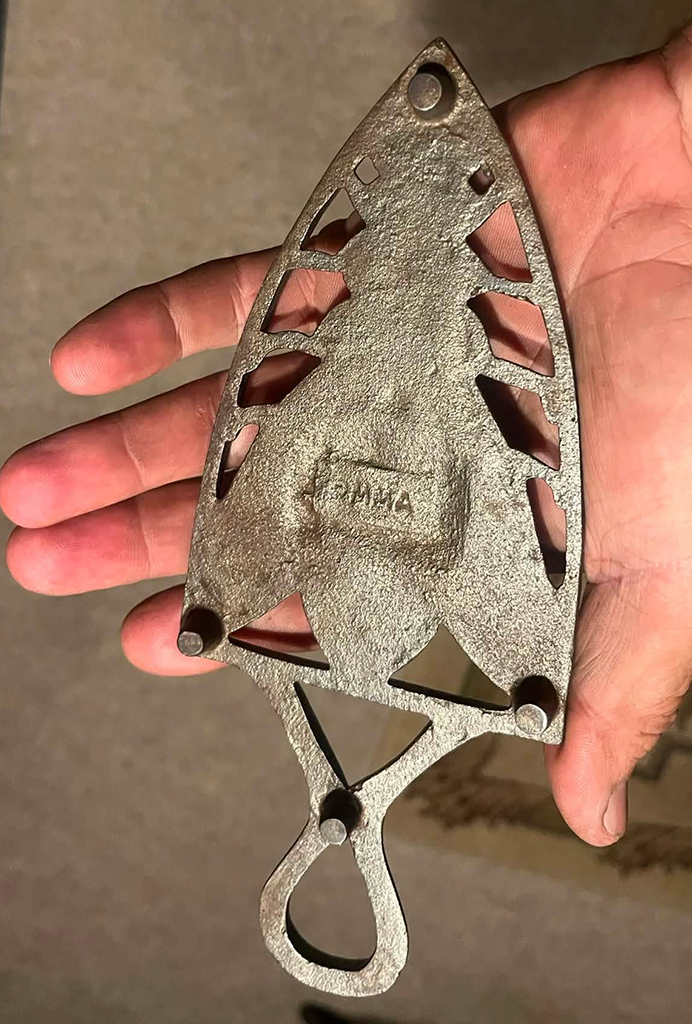
Be aware that there’s a Metropolitan Museum of Art reproduction of the Fly trivet, signed © MMA on the reverse.
Update 1/21/20
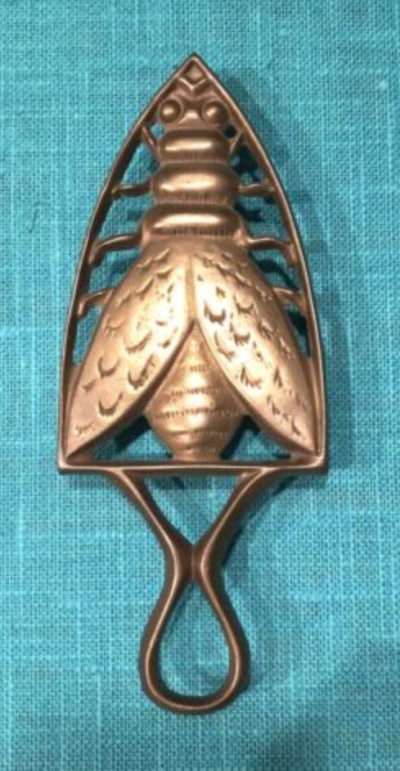
This is a brass version. Its measurements (9″ x 3 3/4″ x 1 1/4″ with 3 legs) match the brass trivet documented on p.179 of T&S. It was sold on eBay on 1/21/20 for $201.50. Image courtesy of Debbie MacLeod.
Update 1/25/20
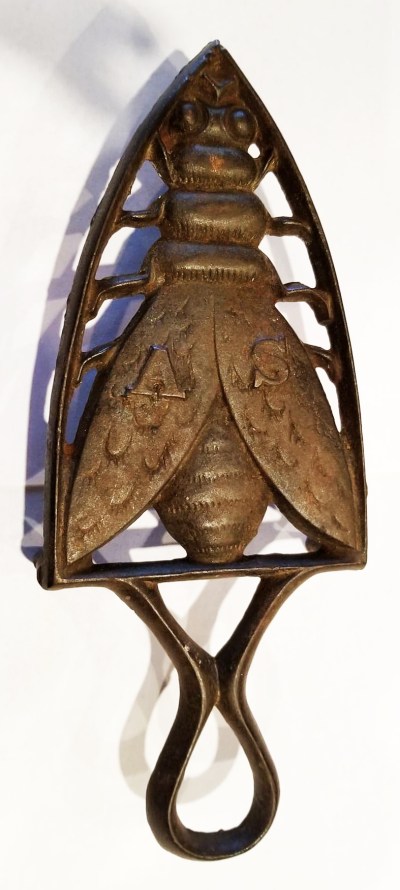
This cast iron version of the fly trivet is identical in size and design with the exception of the letters A S on top. It sold 1/25/20 for $131.50 on eBay. Image courtesy of Connie Denstedt.
Update 8/10/26
This is the modern Metropolitan Museum of Art (MMA) reproduction of the Fly Trivet, circa 1960s. It measures just shy of 9 inches long and 4 inches wide. Note that the repro has 4 legs. Images courtesy of Michael & Anna Pacello.
Related information
“Ned the dog” trivet
The MMA Leaf trivet
The Frank Sahd trivet (the “Good Luck To Us All” design)
I value my readers!  Click below to become a Trivetology Follower. Then you'll receive an email notification of each new blog post.

