
TRIVETOLOGY
Collecting, cleaning, displaying, researching, and appreciating TRIVETS and related go-withs!
Open-handle GW trivet reproductions discovered!

Two examples of the authentic 1876 GW trivet: (L) polished and (R) unpolished.
This brass George Washington (GW) trivet was reportedly designed and produced for the 1876 Centennial in Philadelphia, Pennsylvania. It features an exquisitely designed bust of Washington with an open handle.
It’s documented in The Collector’s Guide To Trivets & Stands by Kelly & Ellwood (1990), rated Rare. Quoted from p.122: “The reverse suggests that the original pattern was sculpted in wax or clay.”
I won this pair of trivets on liveauctioneers back in June 2017 for only $50 plus the 22% Buyer’s Premium and shipping! Both, described as bronze, were received in excellent condition but heavily tarnished. One was kept in its as-found state. The other, after a gentle polishing, appears to be brass; compare the images.
● Brass, measuring 9 5/8″ x 4 1/2″ with three 1 3/4″ long legs.
● Sprue mark on the reverse, above the handle opening.
● The facial features, hair, and shirt/jacket are finely sculpted.
● For additional information see The original George Washington trivet.
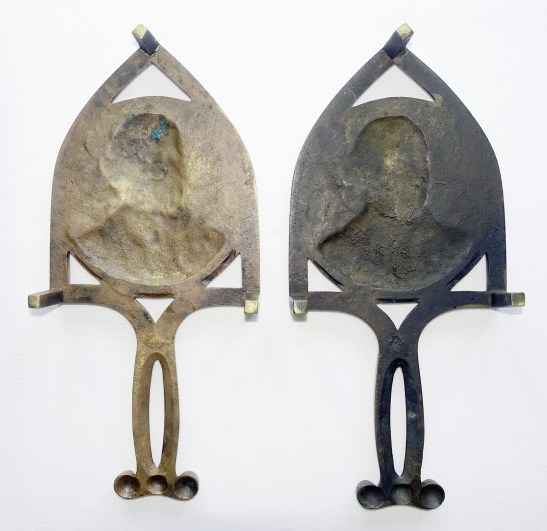
Authentic GW trivets, reverse views which reveal traces of fingerprints.
Discussion
I’d never encountered another GW trivet with an open-handle until recently when I learned of two examples in the same week! An Internet search revealed a third. All have an open handle but there the similarities end.
The three trivets shared below are not as finely designed as the original. Their design has more in common with the various solid-handle George Washington trivet reproductions found in either brass or cast iron.
★ What clues suggest an open-handle GW trivet is a reproduction?
(1) The casting lacks the perfection of the authentic original. Hair is missing on one side of the head and/or the pigtail missing on the other. Facial features are less chiseled and the clothing simpler. The two buttons on the jacket are missing. Compare the details of this original to the three trivets that follow.
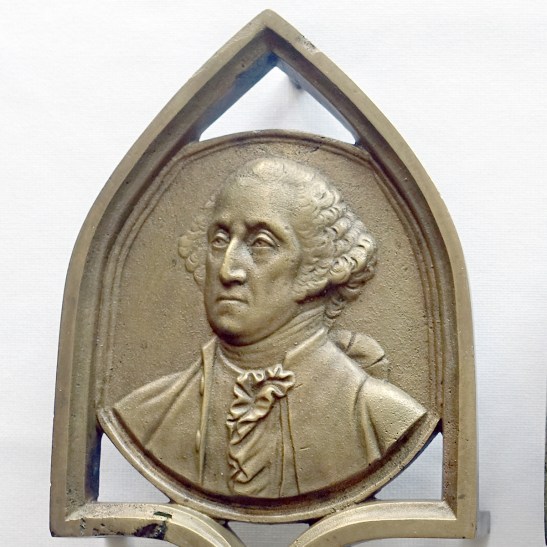
The original features fine detailing in the face, hair, shirt and jacket.
(2) The trivet measures slightly smaller than the original. Recall the rule of One Size Smaller: when a trivet is used as a pattern, any resulting reproductions from that pattern would be slightly smaller due to the shrinkage of molten metal after cooling.
(3) The trivet is larger than, or out of proportion to, the authentic original. That suggests it may be an altered reproduction, ie: marrying an open handle with a reproduced, less detailed platform.
(4) There is no sprue mark. Since the original bore a sprue mark, castings with a gate mark (filed or not) or no visible cast mark are suspect.
(5) Shorter legs. Antique trivets, and early reproductions of those designs, typically have legs over 1″. Most later reproduction trivets have short feet (under 1″) for wall display, but some were intentionally cast with longer legs to mirror the antique version.
Reproduction #1
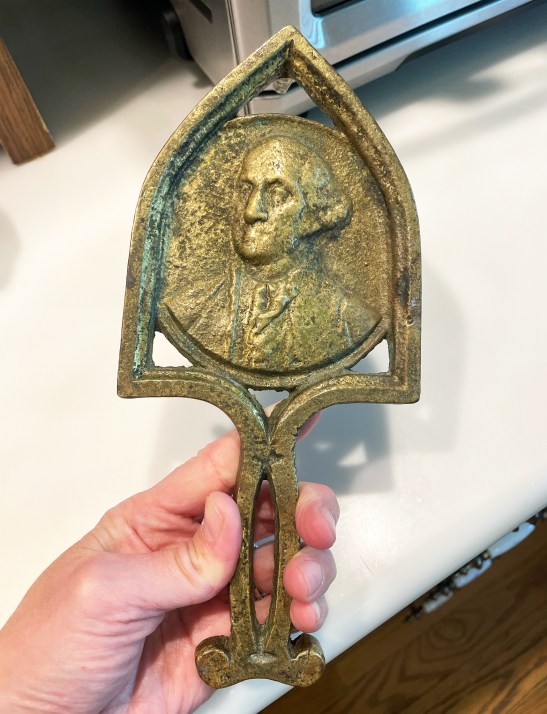
A Trivetology reader contacted me for information on her brass GW trivet. She was hoping it might be an original but, after studying her images, it appears to be a reproduction.
● Brass, measuring 9 3/16″ x 4 3/16″ with three 7/8″ feet.
● No visible cast marks.
● The GW bust is less defined and the features differ from the original.
Reproduction #2
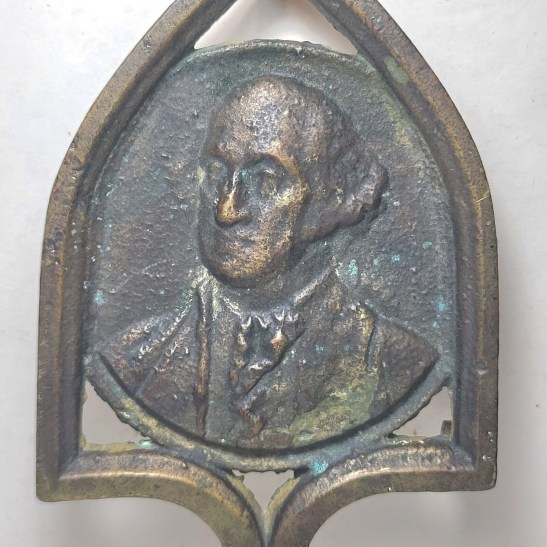
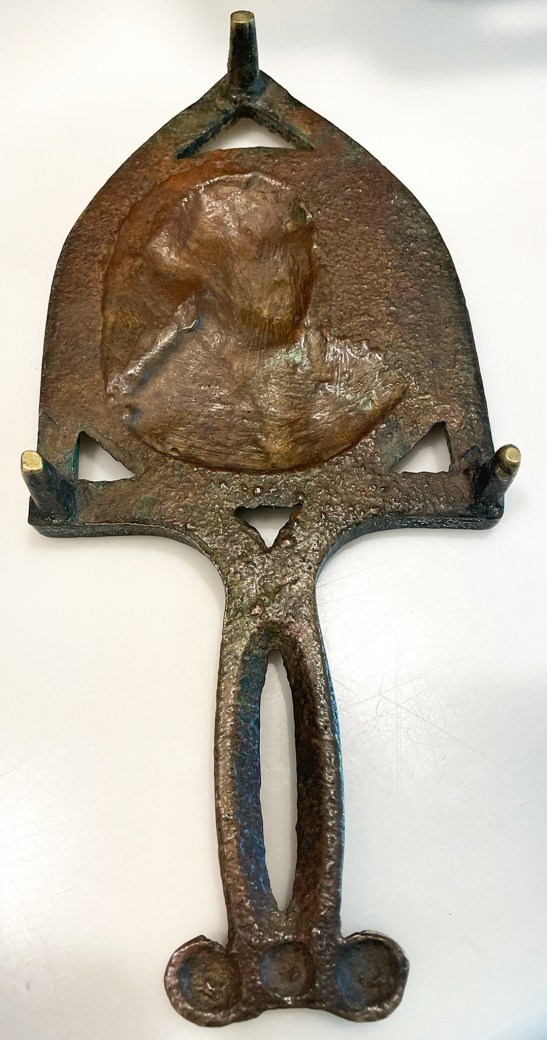
This trivet was listed on eBay as an “Antique Orig. 1876 George Washington Cast Brass Open Handle Trivet.” After studying the listing images I was fairly certain it couldn’t be an original casting so I messaged the seller and provided a link to my GW Trivetology posts. He agreed his trivet was likely a reproduction and removed the listing.
● Brass, measuring 9 1/4″ x 4 1/4″ with three 2″ long legs.
● Uniformly machine filed along one side. Most castings after 1900 were finished by machine grinding which left uniform marks. In contrast, hand filing (pre-1900) left irregular markings.
● The GW bust is less defined and the features differ from the original.
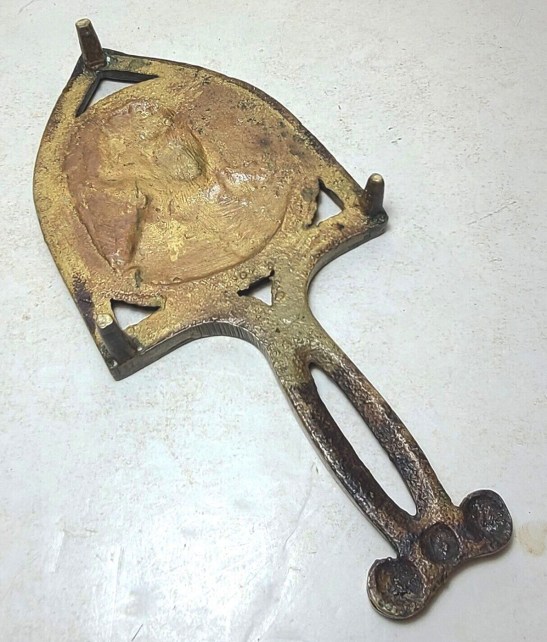
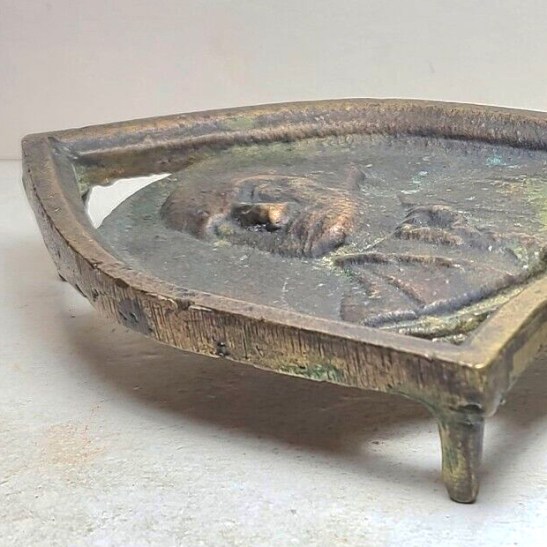
Machine filing along the edge.
Reproduction #3
I discovered a third example on the Roadshow Collectibles website. I attempted to make contact (the website was last updated in 2016) but was unsuccessful. Again, this trivet is not of the quality of the original and likely a reproduction. Click the link to view the website images.
● Brass, measuring 9 1/2″ x 4 3/8″ with three 1 3/4″ legs. Weight: 620 grams.
● The GW bust is less defined and the features differ from the original.
Related Trivetology blog posts
I value my readers!  Click below to become a Trivetology Follower. Then you'll receive an email notification of each new blog post.
 TRIVETOLOGY