
TRIVETOLOGY
Collecting, cleaning, displaying, researching, and appreciating TRIVETS and related go-withs!
W. R. Hatton advertising
In August 2023, after discovering my The Hatton single and double asbestos pad stands blog post, a person by the name of Phil Hatton contacted me with this additional information to share.
My great-great-grandfather was the W R Hatton and his firm sold the sad iron stands you describe in a post from 2021. I happen to have one of them although sadly I had to buy it at auction. My grandfather was the last to own W R Hatton & Sons and had one of the single iron stands he used as a doorstop.
I have a Victorian era catalog that shows the iron stands. They are described as HANDY, SIMPLE, PORTABLE AND PRACTICALLY INDESTRUCTIBLE. I also have one of the galvanized reversible iron stands which is shaped more like an iron.
Several years ago I had that page of the catalog reproduced on aluminum signs and made picture frames for them. I posted a video on my YouTube channel about making the picture frames and the iron stands feature prominently in that video. Regards, Phil Hatton
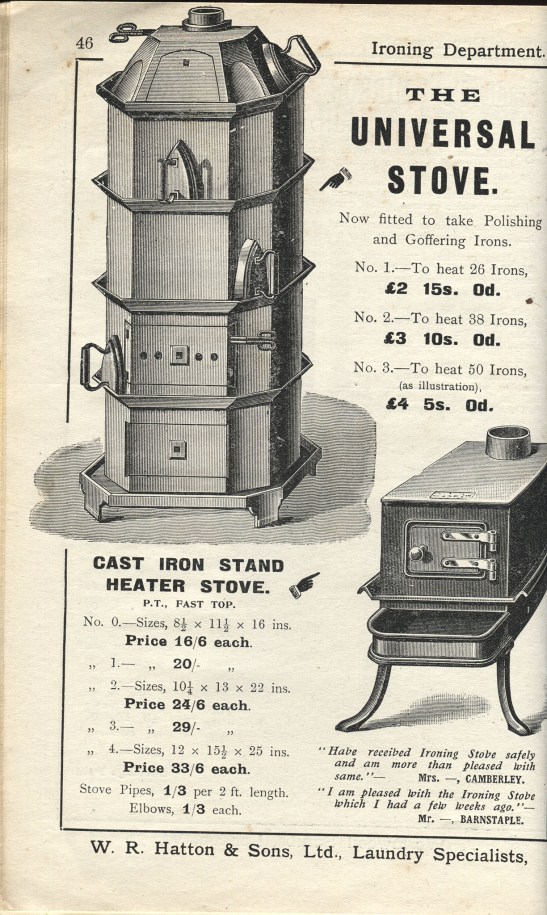
The two pages that follow are from his undated Hatton Laundry Lore Catalog. FYI, the iron-shaped stand features the same inscription on both sides: W. R. HATTON & SONS WORMWOOD SCRUBS LONDON.

Two images from an undated Hatton “Laundry Lore” Catalog.
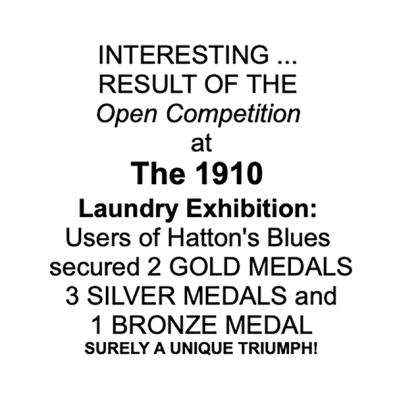
Although the Hatton catalog is undated, the following accolade in the ironing section provides a clue to the catalog’s age. Using this as a reference point, the catalog can be dated to 1910 or beyond.
 So far I’ve been unsuccessful in finding any Hatton UK company history, either via the Internet or in reference books. I will continue my research and, if anyone has information to share, please Contact Me.
Thanks again to Phil Hatton for taking the time to contact me and share this information. Finally, as mentioned above, here is his video. Clicking on the words YouTube will take you to his YouTube Channel where you can give him a thumbs up! 👍
PS: Like me, while watching the video you might have been expecting Phil to have an English accent. I asked him about that and he replied “My family moved to the United States in the late ’60s and I was born here a couple of months later. I did actually have an English accent until I went to school.”
3 comments on “W. R. Hatton advertising”
I value my readers!  Click below to become a Trivetology Follower. Then you'll receive an email notification of each new blog post.
 TRIVETOLOGY
Shared by Tony Stead at the Pressing Iron Enthusiasts Facebook group: “They also have a flat iron with their name on and, stranger still, a crimper identical to the American Crown crimper but the base plate has the Hatton name and address on. I assume they were made in the US and shipped to the UK but would like to find out more ….”
Update: Thanks again to Phil Hatton for this additional information!
W. R. Hatton & Sons was not a foundry. Their three pressing iron stands, that bear company advertising, would have been contracted out.
Instead, the Hatton business model was as a laundry supplier. Many items in the Laundry Lore catalog were directly made by the Hatton firm. It produced bleach, starch, and bluing products as well as laundry necessities like shirt forms, hampers, drying racks, sock forms, and wooden coat hangers.
The wire coat hanger was invented in the United States in 1903. The Hatton firm bought machines from Belgium and Italy that held giant spools of wire and bent them into this newfangled thing called a wire coat hanger. Hatton went on to produce millions of wire coat hangers.
Regarding their liquid laundry bluing product: The firm used fuming sulfuric acid (also known as oleum) to dissolve cakes of indigo from India. Phil’s father remembers during World War II, when oleum was unavailable, the Hatton company tried using regular, industrially available sulfuric acid – but it was not strong enough.
Very interesting, thank you for sharing these background details.