
TRIVETOLOGY
Collecting, cleaning, displaying, researching, and appreciating TRIVETS and related go-withs!
Websites & References
Online Catalogs
● Bridge & Beach Mfg. Co., Superior Stoves & Ranges (1913), PA Power Library. Many cast iron stoves included “stove trivets” that were attached to the framework.
● The Enterprise Manufacturing Company of PA (1904), HathiTrust. A descriptive catalogue of patented hardware specialties.
● Indiana Stove Works, The Darling Line (1910), PA Power Library. Many cast iron stoves included “stove trivets” that were attached to the framework.
● The J.E. Shepard & Company (1983-1884), Internet Archive. This catalog includes 11 pages of information on stove pipe trivets
Online Books
Cohen, Adam. The Perfect Store (2002) @ Internet Archive. All about the early years of eBay.
Harry Rinker
● Rinker On Collectibles (1989) @ Internet Archive
● How To Think Like A Collector (2005) @ Internet Archive
● Sell, Keep, Or Toss? (2007) @ Internet Archive
Other Online References
History Of The Manufacture Of Iron In All Ages (1884), Internet Archive.
Trademarks on Base-Metalware (1991), Internet Archive.
Websites
● The Kevin Talks Irons series of videos on YouTube explores the world of iron and trivet collecting. Videos #13, #65 and #77 feature sad iron stands/trivets.
● Lee Maxwell’s Washing Machine Museum in Colorado is in the Guinness Book of Records. Maxwell is the author of the book “Save Women’s Lives ~ History of Washing Machines”. Watch a tour video of the museum.
● Vintage Electric Irons is the informative blog of Jay Raymond (see his two books below).
● The Museum of Romanian Records is located in Bucharest, Romania. It houses the world’s largest collections of trivets, pressing irons and corkscrews. Tours are available by reservation.
Physical Books
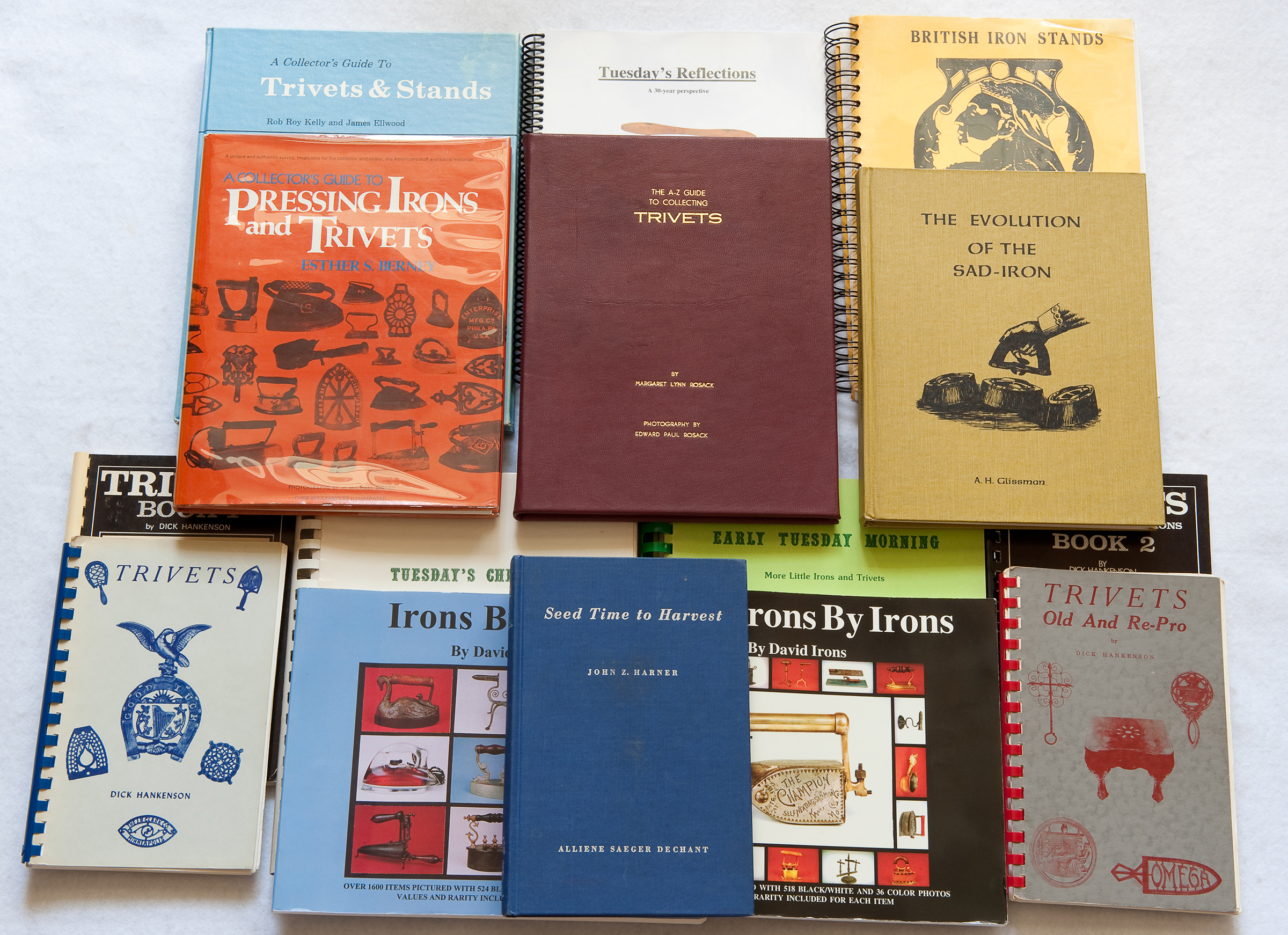
Nothing compares to a physical reference book when researching antiques and collectibles! I access my library frequently and display my reference books and catalogs alongside my collectibles.
The following resources are my favorites. Although the majority are older and out of print, most titles are still available online in the resale market at a reasonable price. They are worth adding to your reference library because they provide information sometimes otherwise unavailable.
Iron and Trivet References
1. Berney,Esther (1977). A Collector’s Guide To Pressing Irons & Trivets. It’s helpful to see irons and their companion trivets together. There is an entire chapter devoted entirely to trivets.
2. Dechant, Alliene Saeger (1957). Seed Time To Harvest. This is John Zimmerman Harner’s autobiography, as told to Dechant. A very interesting book!
3. Deeley, Robert with Andrew Crawforth & David Pearsall (2011). The Cauldron, The Spit & The Fire. This gorgeous book illustrates how our ancestors lived with and used the wrought iron and cast metal items we collect. Several pages illustrate 18th and 19th century trivets and footmen.
4. Geisert, Jim & Robin (2007, final update 2022). Tuesday’s Reflections: A 30-Year Perspective. This is a beautifully photographed, self-published wire-bound catalog of the little irons and trivets in their collection. It makes a nice modern complement to the Politzer books. This book was updated in 2021 and a final time in 2022; contact Jim & Robin to purchase a copy.
5. Glissman, A. H. (1970). The Evolution of the Sad Iron. This was the first definitive American text on pressing irons.
6. Hankenson, Dick (1972). Trivets Book 1 and Trivets Book 2. Dick Hankenson’s books were the first pertaining exclusively to trivets. They were well received, finally giving collectors and dealers the information they needed to identify and describe trivets. It appears Hankenson assigned named to many of his trivets, and collectors continue to use those terms. Although much of the information is outdated by today’s standards, the author’s love of trivets is obvious. Keep in mind also that Hankenson’s definition of “rare” was pre-internet.
7. Irons, David. Irons By Irons (1994), More Irons By Irons (1997) and Even More Irons By Irons (2000). This three book series will answer any question you might ever have about a pressing iron.
8. Kelly, Rob Roy and Ellwood, James (1990). A Collector’s Guide To Trivets & Stands. Often referred to as the trivet collector’s bible, with good reason! This book contains information on foundries and casting, trivet makers and distributors, trivet designs, and how to date a trivet. There are nearly thirteen hundred trivets pictured, along with comments on dimensions, weight, # of legs, markings and scarcity. It’s a must for every trivet collector!
9. Mitchell, Hazel (1991). British Iron Stands. This spiral bound book was assembled for the 8th International Congress of Iron Collectors. Only 100 numbered copies of this work were published; finding a copy can be challenging.
10. Politzer, Judy. Tuesday’s Children (1977) and Early Tuesday Morning (1986). Politzer’s two books are packed with information on toy-sized irons and their matching trivets. The sole-plate of each iron is traced to assist in identification. FYI, the Politzer estate assigned the rights to the remaining books to PITCA and new – old stock copies are still available. Order yours from PITCA while they last!
11. Raymond, Jay. He is the author of Streamlined Irons (2008) and the gorgeous coffee table size book Mangle Boards of Northern Europe (2015) which was reviewed by the New York Times.
12. Rosack, Margaret Lynn: You’ll find information on my two trivet books on a separate page.
13. Slesin, Suzanne and Rozensztroch, Daniel (1994). Everyday Things Wire. If you have wireware in your collection you definitely need this reference book. The history of wireware is discussed and both trivets and sadiron stands are illustrated.
Sprinkler Bottle References
1. Bercovici, Bryson and Gilham: Collectibles for the Kitchen, Bath and Beyond, 2nd Edition, 2001. This book contains a 22 page illustrated chapter detailing the most collectible ceramic, plastic and glass sprinkler bottles.
2. Giacomini, Mary Jane: American Bisque Collectors Guide with Prices, 2015. Schiffer Publishing Ltd. Several sprinkler bottles are documented on pp. 140-141.
3. Historical Society of York County: Pfaltzgraff, America’s Potter, 1989. York Graphic Services, Inc. Information on the Myrtle laundry sprinkler appears on pp. 65-66.
4. Kopish, Donna: Mother in the Kitchen: The Beautiful Lady, 1994. R.L.K. Industries. At 62 pages, this is the first of two references on the Enesco line of Mother in the Kitchen (aka Prayer Lady) ceramic giftware.
5. Kopish, Donna: Mother in the Kitchen and Other Prayer Pieces, 2000. R.L.K. Industries. At 98 pages, this updated version includes more images and information.
6. Stahmer, Deborah: Mother in the Kitchen, The Collector’s Guide to Prayer Ladies, 2007. 4th Edition, Print-On-Demand by Blurb, Inc. in softcover or hardcover. This book is the definitive reference on Mother in the Kitchen giftware.
Other References
1. Cheadle, Dave: Victorian Trade Cards, 1996. Collector Books. Includes 2 pages on Enterprise and Mrs. Potts Sad Irons.
2. Maxwell, Lee: Save Women’s Lives, 2003. The first and only book containing a comprehensive history of washing machines.
I value my readers!  Click below to become a Trivetology Follower. Then you'll receive an email notification of each new blog post.
 TRIVETOLOGY